
Solopreneur OS — Do Not Sell Time. Expand the System.
A personal business operating system for turning specific knowledge, accountability, and leverage into assets that work beyond your direct hours.
LIFE OS — Solopreneur 002
Solopreneur OS is not a guide to making money alone. It is a system for discovering your specific knowledge, putting your name behind it, compressing it into repeatable systems, and turning media, code, products, and brand into assets that can work without selling every hour again.
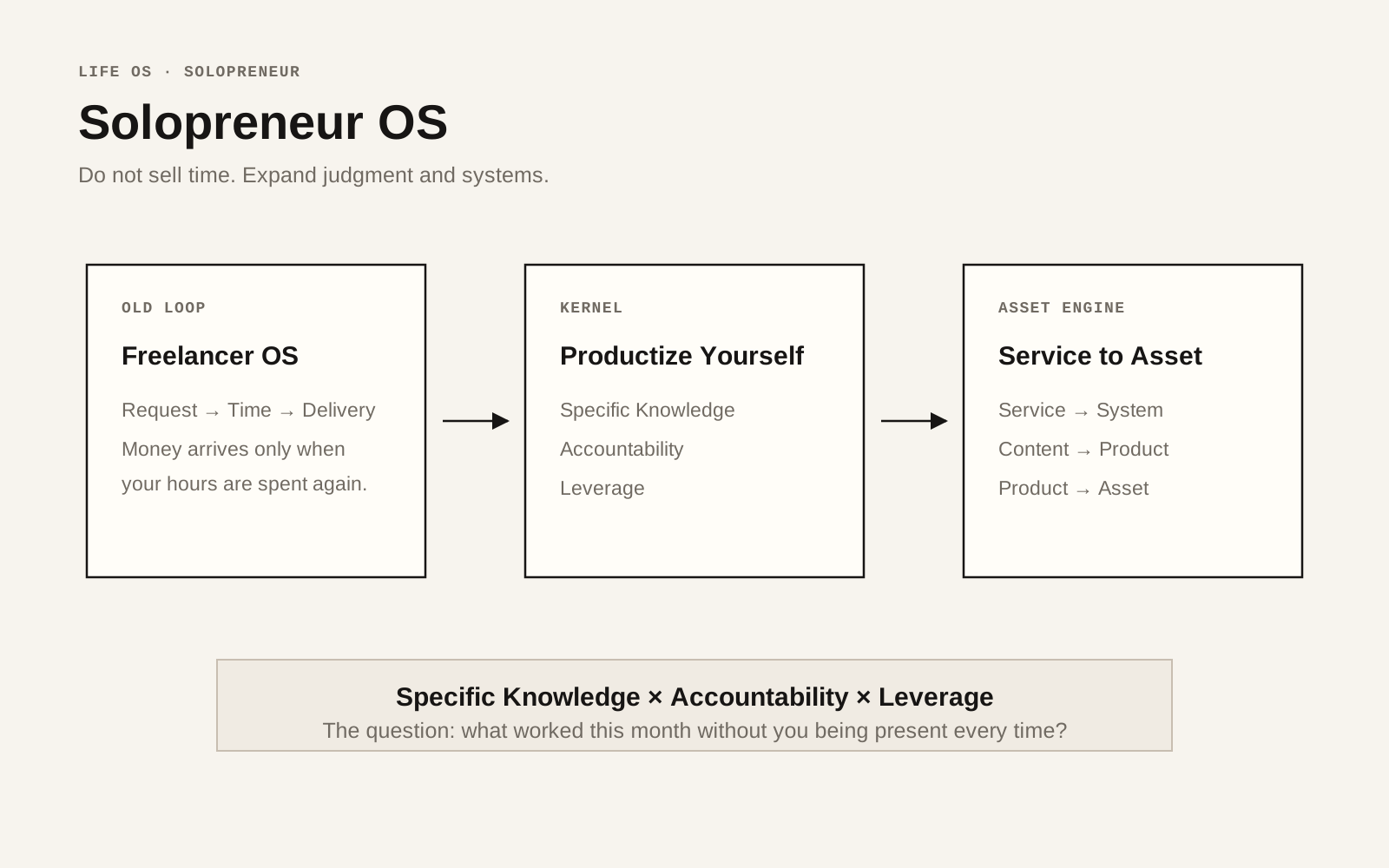
One-Line OS
Turn your specific knowledge into a responsible public promise, compress it into repeatable systems, and use leverage to build assets that work beyond your direct time.
Shorter:
Do not sell time. Expand judgment and systems.
Shortest:
Productize Yourself.
This does not mean packaging your personality into a shallow product. It means turning the problems you naturally understand, the patterns you read better than others, and the judgment you have earned into forms the market can use.
Full Map
Specific Knowledge × Accountability × Leverage → Service → System → Content → Product → Asset The shift from selling time to building an asset engine
Solopreneur OS does not begin with “What should I sell?” It begins with a sharper question:
What judgment can I turn into something the market can use repeatedly?
The whole map has six moving parts.
Specific KnowledgeThe problem space you read faster, notice longer, and improve more naturally than most people.
AccountabilityPutting your name behind a judgment so trust can attach to you and compound.
LeverageMedia, code, capital, and products that let your judgment travel without your direct hours.
ProductizationExtracting repeatable steps from service and turning them into a form the customer can use.
OwnershipMaking sure the value accumulates in your website, list, IP, brand language, product, and data.
Distribution LoopPublishing the asset, reading market response, and sharpening the next version of the system.
The goal is not to collect business ideas. The goal is to see where your current work already contains specific knowledge, repeatable patterns, product candidates, and owned assets.
The Core Shift
| Freelancer OS | Solopreneur OS | |
|---|---|---|
| Sells | Time, output, tasks | Specific knowledge, systems, outcomes |
| Growth | More clients, higher rates | Stronger assets, greater leverage |
| Repetition | Starts over per client | Extracts patterns into products |
| Ownership | Client projects | Brand, IP, audience, product |
| Revenue | Earns when working | Assets can compound |
| Core skill | Execution | Judgment + productization + distribution |
Freelancing is not bad. Service is often the first fuel. But if service never turns into a system, you remain trapped in time resale.
The Kernel
Specific Knowledge × Accountability × Leverage Solopreneur Asset Engine
Specific Knowledge is the asymmetric knowledge that feels like play to you but like labor to others.
Accountability means attaching your name to judgment and allowing trust to compound.
Leverage means media, code, capital, product, and systems that make your judgment work while you are not personally present.
Specific Knowledge Engine
Obsession × Skill × Market Pain = Specific Knowledge The intersection of play, ability, and pain
Specific knowledge is not a random niche. It appears where three things overlap:
- Obsession — the problem you keep returning to without being forced.
- Skill — the thing you can actually improve, explain, and handle.
- Market Pain — a real problem other people would pay to solve.
The training question is:
What problem can I think about longer, deeper, and more joyfully than most people?
The Productization Flow
Service → System → Content → Product → Asset- Service reveals real market pain.
- System extracts repeatable patterns.
- Content teaches the pattern and attracts demand.
- Product packages the transformation.
- Asset earns, teaches, or distributes without restarting from zero.
The key question is simple:
What worked this month without me being personally present every time?
Leverage Layers
| Leverage | Role | Examples |
|---|---|---|
| Media | Trust and discovery | Essays, newsletters, posts, video, podcast |
| Code | Repeatability and delivery | Automation, AI workflows, internal tools, no-code systems |
| Capital | Acceleration | Contractors, tools, ads, data, infrastructure |
The rule:
Make one thing work more than once.
Ownership Question
Solopreneur OS asks one question before accepting a new opportunity:
Will this remain as my asset?
Assets include a website, email list, brand language, product, framework, customer insight, data, community, IP, case study, and automation system.
Non-assets include one-off work, underpriced time resale, content that lives only on someone else’s platform, custom delivery that starts from zero every time, and services that cannot run without you.
Decision Filter
When a new opportunity appears, check it against seven questions.
- Does it sharpen my specific knowledge?
- Does it connect to my name and trust in a good way?
- Can it become a repeatable system?
- Can it leave behind content, product, or a case study?
- Does it increase the chance that something works without me?
- Is it in the same direction as the long game?
- Does this work grow or drain the energy needed for the business?
The conclusion:
Do not choose opportunities. Choose systems.
Weekly Operating Loop
MondayChoose one bottleneck for the week.
Tue-ThuGo deep on one lane: content, product, sales, or system.
FridayPut what you made into the market.
WeekendReview what sold, resonated, drained you, or can be systemized.
The monthly question matters most:
What worked this month without me being present every time?
What To Build
Solopreneur assets usually begin as small things.
- A repeated client process becomes a checklist.
- A checklist becomes a template.
- A template becomes a guide.
- A guide becomes a product.
- A product becomes a system with onboarding, delivery, feedback, and distribution.
The goal is not to become passive. The goal is to stop confusing busyness with ownership.
Broken OS Symptoms
- You are busy but no asset is accumulating.
- Every client makes you start from zero.
- You depend only on platform algorithms.
- Custom response keeps crowding out product.
- Revenue exists, but identity is blurry.
- You build without distribution.
- Short-term money keeps damaging the long game.
- You do everything alone without leverage.
Installation Order
- Find specific knowledge candidates.
- Choose one customer group.
- Serve directly.
- Record repeated patterns.
- Turn the pattern into a method.
- Publish it as content.
- Productize it.
- Secure ownership.
- Automate and delegate.
- Move into the long game.
Training Prompt Mode
The training tab should not act like a generic startup chat. It should listen to the user’s actual work and extract the judgment and system that could become an asset.
A strong coach answer should move in this order.
- Current bottleneck — Decide whether the user is stuck in time resale, custom delivery, weak distribution, delayed productization, or lack of ownership.
- Specific knowledge candidate — Identify what problem the person reads unusually well, what role they keep being asked to play, and what obsession keeps returning.
- Service-to-system extraction — Pull a checklist, framework, template, or automation candidate out of one recent piece of labor.
- Product candidate — Decide whether the system should become content, guide, template, course, tool, community, or retained service.
- Leverage choice — Choose whether media, code, or capital should be used first.
- Seven-day asset action — Name the smallest asset the user can leave behind this week.
If the user is vague, do not lecture. Ask one question:
What have you explained, organized, or solved repeatedly in the last two weeks?
The job of the OS is to find the asset hiding inside that answer.
Deep Principle: Why The Freelancer Loop Does Not Break By Itself
The most common solopreneur mistake is believing that doing good work will naturally produce products later. In practice, the opposite happens. The better you are at custom work, the more customers ask for custom work. The more custom work you accept, the less time you have to extract systems.
The freelancer loop reinforces itself:
more client requests
  → more urgent delivery
  → less time for recording and productization
  → the next client starts from zero again
  → more time resale
Raising your rate does not automatically break this loop. It may only turn you into a more expensive time seller. Solopreneur OS inserts an extraction point inside the work itself.
client request
  → direct service
  → record repeated questions
  → extract diagnosis sequence
  → build checklist or template
  → publish as content
  → productize
  → onboard the next customer through the asset
The key is not working harder. The key is extracting while working.
If you wait until the project is finished, extraction usually fails. The next request arrives, memory fades, and the repeatable pattern disappears. Every service engagement therefore needs a small capture device:
- the customer’s original language,
- the point they misunderstood,
- the sequence you used to explain,
- the criteria that changed the decision,
- the intervention that improved the outcome,
- the question the next customer will also ask.
Without capture, experience becomes fatigue. With capture, experience becomes raw material for a system.
Four Levels Of Specific Knowledge
Specific knowledge is not simply a topic you like. It must become judgment the market can repeatedly use. This OS reads it in four levels.
| Level | State | Question |
|---|---|---|
| Interest | You enjoy the topic | What do I keep looking at? |
| Sense | You see patterns early | Where do others get lost while I see structure? |
| Judgment | You can choose and reject | What should be done, and what should be avoided? |
| System | Others can use the sequence | Can this become a checklist, template, or diagnostic tool? |
Many people stop at interest. Interest can create content, but it is not yet a business engine. Sense is stronger, but it still lives inside you. Judgment makes the market begin to trust you. System makes productization possible.
“I am interested in AI” is not specific knowledge. “I understand where Korean small businesses get stuck when turning phone FAQ into AI workflows, and what data structure and tone actually work in operations” is specific knowledge.
“I like health” is not specific knowledge. “I can tell when a burned-out founder will be damaged by more exercise and which pressure signals need to come down first” is specific knowledge.
“I enjoy writing” is not specific knowledge. “I can turn a complex theory into a map, formula, diagnostic questions, and training loop a reader can use” is specific knowledge.
The training tab should locate which of the four levels the user is currently in, then move them one level up.
Accountability Layer
For a solopreneur, a name is not decoration. It is an account where trust accumulates.
The market is full of similar advice, templates, and services. The difference is who is willing to attach their name to a judgment, absorb the result, and keep playing the same game long enough for trust to compound.
When the accountability layer is weak:
- there is content but no point of view,
- execution happens but trust does not accumulate,
- projects exist but your name does not become a reference,
- collaboration happens but no owned asset remains,
- failures stay hidden, so learning never becomes public,
- wins happen, but the market does not remember whose judgment created them.
When accountability is strong:
- you define problems under your own name,
- you propose methods under your own name,
- you promise outcomes under your own name,
- you publish failures and corrections under your own name,
- you set standards for what you do not do.
Accountability is not performance. It is attribution of judgment. If the judgment is right, trust compounds. If it is wrong and corrected in public, learning compounds. Both can become assets.
Productization Judgment
Not every piece of knowledge should become a product immediately. Productizable knowledge usually has seven signals.
- Repetition — the same problem appears across multiple people.
- Sequence — the solution has an order.
- Error pattern — people repeatedly make the same mistake.
- Before/after difference — progress can be seen.
- Self-use potential — the customer can perform part of the process without you.
- Measurability — the result or progress signal is observable.
- Updatability — the asset can improve over time.
Knowledge that does not productize is often too personal, too abstract, or too dependent on one-off judgment. That does not mean it cannot become an asset. It usually means you need to move one step lower first: diagnostic sheet, case library, checklist, question cards, or example bank.
Think of the productization ladder this way:
spoken explanation
  → checklist
  → diagnostic sheet
  → template
  → workbook
  → mini-course
  → coached session
  → automation tool
  → membership / OS
You do not need to begin with a full course or SaaS product. A small diagnostic sheet may be more powerful. If it lets the customer classify their own state, it becomes content, product, sales tool, and coaching tool at once.
Leverage Sequence
Leverage is not always good. If the sequence is wrong, leverage only scales confusion.
The safer early sequence is:
- Media — publish judgment and read market response.
- Service — learn real customer obstacles directly.
- System — turn repeated diagnosis into a repeatable sequence.
- Code — reduce repetition and stabilize quality.
- Product — let customers get part of the result without your direct hours.
- Capital — accelerate a system that has already been validated.
Common failures come from reversing the order:
- building a product without market response,
- automating before a repeatable pattern exists,
- buying ads before the message is clear,
- branding before specific knowledge is sharp,
- producing only platform content without owned assets.
Leverage is an amplifier, not an engine. If judgment is weak, leverage amplifies weak results. If positioning is unclear, leverage amplifies noise. Judgment comes first.
Ownership Design
Every week, Solopreneur OS asks:
Where did this week’s work accumulate?
Did it accumulate only on someone else’s platform? Only in the client’s document? Only in your head? Or did it accumulate in your website, list, product, data, framework, or automation system?
Ownership has five layers.
| Layer | Meaning | Examples |
|---|---|---|
| Language ownership | Your way of naming the problem | ”selling time”, “asset engine”, “service-to-system extraction” |
| Relationship ownership | People you can reach directly | email list, community, CRM |
| Knowledge ownership | Judgment that can be reused | frameworks, diagnostic tools, case library |
| Product ownership | A structure that accepts payment | templates, courses, toolkits, memberships |
| System ownership | An operating loop that repeats | onboarding, automation, reports, publishing rhythm |
Every piece of work should accumulate in at least one of these layers. Otherwise revenue may exist, but compounding does not.
Opportunity Examples
Example 1: High-fee custom project
It looks attractive. The money is good and the client is real. But if everything must be done from scratch, no public case can be created, and nothing connects to your product path, the project may be dangerous.
OS read:
- specific knowledge: low to medium,
- ownership: low,
- productization: low,
- short-term revenue: high.
Decision: accept only if the agreement lets you generalize part of the work into a diagnostic tool, checklist, anonymized case, or framework. If nothing can remain, raise the price or decline.
Example 2: Small free essay series
It may not pay immediately. But if it sharpens your specific knowledge, becomes search traffic, leads to email subscribers, and later becomes course modules, it is a strong asset.
OS read:
- specific knowledge: high,
- ownership: medium to high,
- productization: high,
- short-term revenue: low.
Decision: publish it, but do not let it remain as pure content. Attach a diagnostic question, checklist, or product candidate to each piece.
Example 3: High-reach platform content
Views are not ownership. A platform post is useful only when it moves people toward your website, list, product, framework, or owned language.
Decision: measure not only reach, but conversion into owned relationships and reusable assets.
Energy Is Hidden Capital
For a solopreneur, energy is capital. An organization can absorb part of an individual’s energy drop. A solo business usually cannot. When the founder’s energy collapses, the business stops.
Energy drains:
- meaningless meetings,
- low-rate repeated work,
- vague clients,
- excessive customization,
- endless revisions,
- social comparison,
- status games,
- unclear projects,
- emotionally expensive low-margin work,
- customer segments that do not match the OS.
Energy builders:
- deep work,
- writing,
- product improvement,
- conversations with good customers,
- repeatable systems,
- automation,
- exercise and sleep,
- learning,
- case-study reviews,
- work that compounds.
The solopreneur does not grow by doing more. They grow by removing work that should not be done.
Dashboard
Use a small dashboard. Too many metrics turn into another form of noise.
| Area | Core Question |
|---|---|
| Specific knowledge | Did my point of view become sharper this week? |
| Accountability | Did I publish a judgment under my name? |
| Content | What asset did I publish this week? |
| Product | Did anything become more repeatably sellable? |
| Distribution | Did the message reach more of the right people? |
| Ownership | Did list, website, IP, or data accumulate? |
| Revenue | Did non-time-resale revenue increase? |
| Energy | Do I still have energy to keep playing this game? |
The monthly question matters most:
What worked this month without me being present every time?
Detailed Weekly Loop
The OS must repeat. A weekly loop is the simplest unit.
direction → deep work → distribution → feedback → productization → reviewMonday: Direction
Pick one bottleneck.
What would actually move the business forward if finished this week?
Do not start with a task list. Decide whether the bottleneck is content, product, sales, or system.
Tuesday To Thursday: Deep Work
Stay in one lane: content, product, sales, or system. Freedom creates drift. Rhythm protects freedom.
Friday: Distribution And Feedback
Put the week’s work into the market.
- publish an essay,
- send a newsletter,
- interview a customer,
- update a product,
- improve a sales page,
- share with a community,
- test a small offer.
Creation without distribution often becomes self-comfort. The market is rough, but it gives feedback.
Weekend: Review And Productization
Ask four questions.
- What sold?
- What resonated?
- What drained energy?
- What can be systemized?
This loop turns work into operating cadence rather than mood.
Training Round Example
User input
“Customers keep asking me to set up AI automations. I explain and configure things every time. I earn money, but nothing really remains.”
OS diagnosis
The bottleneck is delayed productization. The specific knowledge candidate is not “AI automation” in general. It is “where customers get stuck when attaching AI automation to real workflows.” That can become a diagnostic tool and onboarding system.
Service-to-system extraction
Repeated sequence:
- map the customer’s workflow,
- classify repeated tasks,
- locate the data,
- decide what can and cannot be automated,
- check risk points,
- install the smallest useful automation,
- teach usage,
- review after one week.
This sequence is the skeleton of a product.
Product candidates
- free content: “8 checks before automating work with AI”,
- lead asset: automation readiness diagnostic,
- small paid product: 90-minute automation diagnosis,
- template: automation requirements workspace,
- high-ticket service: design, install, and stabilize the workflow for two weeks.
Seven-day asset action
The goal this week is not to explain better. It is to build an asset that reduces explanation.
- Today: collect the last ten customer questions.
- Tomorrow: sort them into diagnosis, setup, operation, and risk.
- Day 3: create a one-page readiness diagnostic.
- Day 4: apply it to one existing customer.
- Day 5: write an anonymized case.
- Day 6: publish the case.
- Day 7: connect the diagnostic to a booking or email flow.
Now labor leaves an asset behind.
What The Coach Must Never Do
The Solopreneur OS coach must not fall back into generic startup advice.
Do not:
- say “post more on social media” as generic advice,
- stop at “choose a target customer”,
- listen to the user’s work without naming a specific knowledge candidate,
- motivate without identifying a productization path,
- ignore ownership and distribution loops,
- end without a seven-day asset action.
A strong answer changes the user’s perception of their own work. They should leave thinking: “This repeated service is actually judgment,” “This should become a diagnostic sheet first,” or “This week I should build an asset that reduces future explanation.”
One Sentence
The solopreneur does not escape work; they turn earned judgment into assets that can compound.